The Promise and Tragedy of the Popular Front
In interwar Europe, the rise of Hitler and Mussolini forced leftists into pragmatic alliances. The popular fronts they built were a defense against fascism, but also pointed to how to win broad-based social reform.
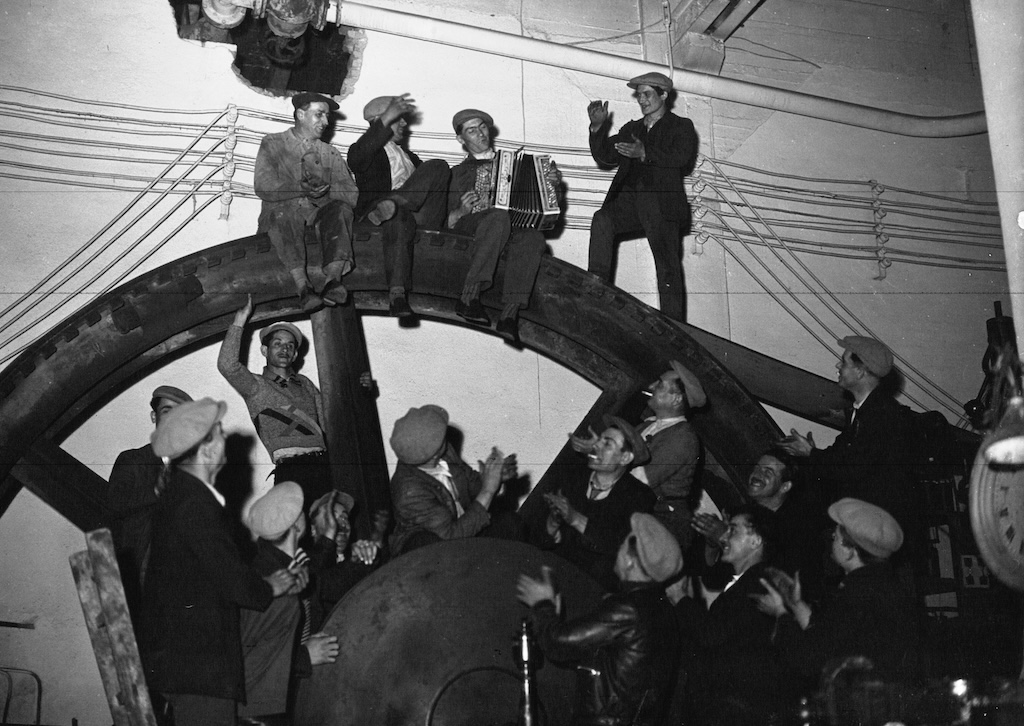
French laundry workers participate in the unprecedented wave of strikes and occupations that took place during the first Popular Front government in June, 1936. (Bibliothèque nationale de France)
A wave of revolutionary optimism swept across Europe after World War I, as Communists and the independent revolutionary left forged a new radical political identity by separating themselves from social democracy. Yet in the years that followed, this initial revolutionary enthusiasm was replaced by a series of devastating defeats and retreats. The deep and seemingly permanent divisions of the international left persisted, leaving it weak and fragmented when fascism came to power in Italy in 1922 and in Germany in 1933.
A widespread longing for left-wing unity soon began to emerge among both Communists and social democrats. Yet, it was only in the mid-1930s that a new vision and strategy of such unity was officially introduced: the so-called Popular Front, inaugurated by the Communist International (Comintern), and most famously practiced in France, Spain, and Chile. The Popular Front proved crucial in establishing bulwarks against fascism’s further rise. However, its left-wing components failed to advance their long-term goal of socialism.
But with the far right again on the rise, what can the contemporary left learn from the Popular Front’s ambivalent legacy?
A New Approach
The concept of the Popular Front was deeply embedded in French politics of the interwar period. Its immediate origins can be traced to the events of February 6, 1934, when the far-right Croix-de-Feu (“Cross of Fire”) staged a protest march through Paris that ended in violent clashes and uncontrolled rioting. France suddenly appeared to be on the verge of a fascist coup, and the need to defend the democratic republic grew acute. A major anti-fascist rally followed on February 13 in Paris, where rank-and-file Socialists and Communists spontaneously joined forces. The pressure from below was formidable as demands for united action against the fascist threat grew adamant.
The Communists had issued calls for “united fronts” (i.e., common activity between social democrats and other socialists) for decades, but it was French Communist leader Maurice Thorez who, in 1935, publicly took the initiative to expand the vision of anti-fascist unity beyond the traditional Socialist/Communist nexus to include middle-class parties. This marked the birth of a global concept of the Rassemblement populaire, more commonly known as the Front Populaire or, in German, Volksfront.
The Communists revised their strategic approach of the previous decade. They not only reached out to Socialists and social democrats, but also to liberals, the middle classes, progressive intellectuals, and even Christian conservatives to form a common front against the far right. The Popular Front policy signified a humbling recognition of how weak the Communist parties had become. Internationally marginalized by years of left-wing sectarianism or crushed outright in fascist countries, they were clearly unable to fight off the far right alone. The Popular Front also marked the end of the Communists’ catastrophic conflation of “bourgeois democracy” with fascism that infamously and disastrously had been implemented in Weimar Germany.
Did the Popular Front represent an enduring departure from revolutionary politics and toward gradualism in Europe, or the launch of a completely new vision of an anti-fascist democracy? After all, coalitions with non-socialist parties were unavoidable if fascism was to be successfully combated. Accordingly, the Left could not always expect to be the leading force, as historian Geoff Eley suggests in his classic study Forging Democracy: The History of the Left in Europe, but would be forced to accept “periods of moderation, defensive consolidation, and slow advance.” It became increasingly clear that democratic societies had a very low tolerance for political violence or dogmatism. Consensus and compromise seemed to be the only way to secure socialist influence on the governmental level.
Toward an International Movement
Only after the Nazi Party rose to power in Germany did the Comintern bitterly and belatedly support strategies oriented toward broader unity. At its Seventh World Congress held in Moscow in the summer of 1935, Italian Communist leader Palmiro Togliatti rhetorically asked fellow delegates, “Why do we defend bourgeois-democratic liberties?” given how reactionary the bourgeois-democratic regimes had often been. Despite their flaws, Togliatti continued, had not Weimar Germany or liberal Italy been better for the working class than the open fascist dictatorships that now ruled those countries?
In a groundbreaking intervention, Comintern general secretary Georgi Dimitrov noted how social democracy could no longer be seen as a bulwark of the bourgeoisie — because the bourgeoisie was moving to the far right and itself abandoning its support for bourgeois democracy. The consequence of this general shift to the right was that Communists could no longer choose between “proletarian dictatorship” or “bourgeois democracy,” but rather between bourgeois democracy or a fascist authoritarian dictatorship. The experiences in Italy and especially Germany made the choice clear: the political freedoms established under democracy, even if dominated by the bourgeoisie, were in fact worth defending. Ironically, one of the major political legacies of the Nazi dictatorship was perhaps that it made European Communists finally appreciate liberal democracy.
Dimitrov delivered the key programmatic speech on how the Communist movement was to respond to the fascist offensive. Communists were to rid themselves of “self-satisfied sectarianism”: their overestimation of the power of the Left and the revolutionary spirit of the people had been a major mistake. In this new situation, they should be prepared to “defend every inch of bourgeois-democratic liberty.” Communists could participate in united-front or popular-front governments as long as they were based on an anti-fascist platform, for they alone were not strong enough to hold off the fascists — they needed allies.
The Comintern warned on the one hand against underestimating the dangers of fascism but, on the other, refused any fatalistic thinking: fascism’s victory was not inevitable, and the Popular Front could be a powerful bulwark against it. Communist parties thus pivoted toward electoral politics and establishing common platforms in a broader anti-fascist front.
Importantly, they sought to collaborate with the left wing of the social democratic parties, movements, unions, and workers who were willing to push the latter toward the left, rather than the center. The Communists perceived themselves as the elemental force that could bring about a broad anti-fascist people’s front with a working-class base, but also expand it beyond classical urban working-class circles into the countryside. The Communists insisted that they present themselves to the masses of the people “as the champions of the liberty and independence of the country.”
The language of the Communist parties also shifted from class struggle to a rhetoric centered around the concepts of “the people” as counterpower, with a new emphasis on parliamentarism and upholding the constitution. Importantly, the Popular Front made the strategic choice to embrace the nation state, which could not be left to the fascists and reactionaries. The Popular Front thereby advanced a strong attachment to the country and its unification: “We boldly deprived our enemies of the things they had stolen from us and trampled underfoot. We took back the Marseillaise and the tricolor,” as Thorez stated in the Popular Front election program. The masses responded by granting the French Communist Party unprecedented electoral success in 1936.
The Popular Front in Practice
The Popular Front constituted an answer to the “longing for unity” deeply felt across the broader left at the time. But given that years of bitter infighting had fostered intense mutual distrust, how could such a popular front be constructed? Skeptics asked whether the move was merely yet another tactical call for unity by the Communists — a trojan horse to disintegrate social democracy through collaboration, an alliance only to be betrayed and severed soon afterward.
In fact, the pioneers of the popular front strategy were found among Communist organizers such as the German publisher Willi Münzenberg and French author Henri Barbusse, who had been involved in building international frameworks for anti-fascist unity committees in Berlin and Paris since 1923. Their greatest achievement was the international antiwar movement founded in Amsterdam in 1932, which quickly morphed into a global anti-fascist initiative known as the World Committee Against War and Fascism. Founded in Paris in 1933, it spanned intellectuals, progressives, socialists, Communists, humanists, and liberals, much akin to the later Popular Front. Their preparatory work, however, did not alter official Communist Party policy at the time. Nevertheless, the Committee offered new ways to collaborate and work against fascism across party lines, which constituted crucial steps for the rebuilding of trust.
The Popular Front was not merely a top-down initiative but based on grassroots pressure for economic change and social reform. Differences within the anti-fascist camp naturally persisted, as did political identities and individual beliefs, but participants emphasized their strongly held, shared belief in democracy and the will to jointly preserve the political liberties guaranteed by the republic.
A nonaggression pact between Socialists and Communists constituted one of the fundamental principles of the new center-left bloc. Communists would no longer issue demands or ultimatums to the social democratic parties only to be met with rejection. Broader unity could only be constructed around compromise. Moreover, according to Togliatti, the Communists were prepared to make concessions.
Far-left critics of the Comintern, including Trotskyists, interpreted the Popular Front as a devastating betrayal of revolutionary politics. Yet Communists opted in this moment for a popularization of democratic socialism with a Communist presence, rather than pursue their own marginalization and revolutionary isolationism as the Trotskyists did.
Strategic and tactical thinking aside, without the external pressure of fascism and the threat of the far right growing even stronger, the Popular Front would most likely have been impossible. But since the French, Spanish, and Chilean Popular Front governments were introduced in moments of deep economic crisis, their room to maneuver was inherently limited.
In all cases, the Popular Front emerged above all as a balancing act to harmonize the interests of labor and capital. Many uncertainties remained: If the Popular Front advanced excessively moderate reforms, its working-class base would be disillusioned, while overly radical reforms would antagonize and frighten the middle classes. Were leftists ready to suppress immediate radical demands within their own base? Were bourgeois liberals or social democrats ready to accept and fight for a more ambitious social and economic policy?
The Spanish Popular Front government elected in February 1936 faced a particularly difficult balancing act. The major concern was that overly radical demands would eventually drive the middle class to the right and collapse the front, or provide an excuse for right-wing forces to stage a coup on the basis of widespread anti-Bolshevik sentiment. The fear of revolution was a potent political drug for the political right, and in Spain, the Comintern urged local Communists not to push the Popular Front government beyond the struggle for a democratic republic and tone down more radical demands for social revolution.
In Chile, the emergence of a Popular Front government did not lead to radical social transformation, but instead to the institutionalization of socialist policies, which could also be seen as a major victory. An interesting tactic employed by the Communists in Chile was to win over a section of the other Popular Front parties’ leadership by directing its working-class voters to center-left candidates. The Communists thus improved their credibility as political allies and provided the Popular Front with a degree of respectability by winning over more centrist and middle-class forces.
Getting off the Defensive
In its most inspirational moments, the French Popular Front possessed a dual character: it was both a powerful anti-fascist mass movement and a functional electoral coalition. Framed differently, the bare minimum for the Popular Front was to protect the state’s democratic system against fascism and to uphold the legal framework that permitted the continued presence of the workers’ movement in the political process.
From a Communist perspective, such fronts were implemented as transitional measures, but Communists of the time did not believe that Popular Front governments could by themselves result in radical social and political reforms. Significantly, trade unions played a crucial role in establishing a balance of power within the Popular Front. In 1936, the French Popular Front was complemented with workplace occupations, a general strike, and spontaneous bursts of optimism as the labor movement was finally in government. French employers also agreed to remarkable compromises.
The initial changes implemented by the first Popular Front government, partly a result of trade union pressure, were indeed impressive: the introduction of paid holidays for workers, a forty-hour workweek, considerable wage increases, and strengthened trade union rights. The 1936 “summer of hope” was captured by the slogan “for bread, liberty, and peace.” Disillusionment and retreat would soon follow. Nevertheless, as Thomas Beaumont has argued, an enduring legacy of the Popular Front in France was the introduction of a collaborative and democratic approach to industrial relations; as such, it served as a crucial testing ground for industrial relations implemented in postwar France.
It remains unclear whether the Popular Front could merely function as a “manager of crisis” or actually serve as a motor of future, long-term societal change backed by a democratic socialist vision. Had the Popular Fronts not been interrupted by civil conflict and world war, could they have moved beyond the defense of liberal democracy — and pushed for deeper social change?
Communists in the mid-1930s developed rudimentary ideas about forging a future form of “anti-fascist democracy,” but these were never fully refined as an alternative to the Soviet model. At the time, Communists did not demand radical reforms in the Popular Font framework because they ultimately did not believe in deeper societal transformations within the confines of capitalism. Neither Communists nor socialists in Popular Front governments had detailed plans on how to steer such governments toward socialism. It thus remains one of the most intriguing tasks of the contemporary left to develop further the concept of an anti-fascist democracy that strives to defend the liberal rights and freedoms of democracy, while pushing for a more ambitious democratic socialist vision with the help of trade unions and progressive social movements.
Perhaps unjustly, the Popular Front today is primarily remembered as a defense mechanism against fascism and the far right, but it should equally be seen as a powerful means to pull the political center to the left. In this way, the idea of the popular front can provide relevant answers to that ongoing “longing for unity” across the Left, but only if simultaneously linked to tangible visions for economic and social justice in a cross-border, democratic framework.